Aaron Amar Bhamra
b. 1992, Vienna, AUT
aaron@bhamra.at
https://aaron-amar-bhamra.com
CV (09.09.26)
_
Gallery contact:
Galerie Martin Janda (Vienna)
https://www.martinjanda.at
galerie@martinjanda.at
_
LAURENZ (co-founder)
since 2020 with Monika Georgieva
https://www.laurenz-space.com
Press(Interview)
_
Aaron Amar Bhamra is an artist based in Vienna whose practice examines exhibitions as spatial metaphors for social and discursive structures. Working across artistic, architectural, curatorial, and educational roles, his work treats the exhibition not as a neutral framework but as a medium through which abstracted structures can be made visible.
Influential to the method of the practice are the contrasting structures of Western and Indian classical music. In Western music, a C# written on paper between five lines follows a fixed system; a C# played on a tuned piano is defined and predetermined. In Indian classical music, by contrast, a SA can be defined freely according to the musician’s chosen scale and instrument, and all subsequent notes are shaped relationally. A sequence such as SA, RE, GA follows the rules of a Raag, which define ascending or descending patterns rather than fixed pitches. This relational logic informs the practice: objects, ephemera, and spatial elements function collectively, their meaning contingent on context, use, and encounter.
The practice engages with representations and abstractions of space—using forms such as floorplans, display architectures, work descriptions, and objects that circulate within exhibition contexts and question autonomy within these structures. These elements foreground the conditions that host and organize artistic production, revealing how visibility, orientation, and interpretation are structured. Using materials such as paper, textiles, printed matter, and spatial traces, Bhamra translates architectural measures and institutional logics into material propositions.
The work unfolds through ongoing processes that emphasize repetition, translation, and context-specificity. Meaning is understood as contingent and relational, emerging through use and encounter. By exposing the infrastructures that underlie exhibition-making, the practice reflects on how artistic forms operate within broader systems of space.
.
.
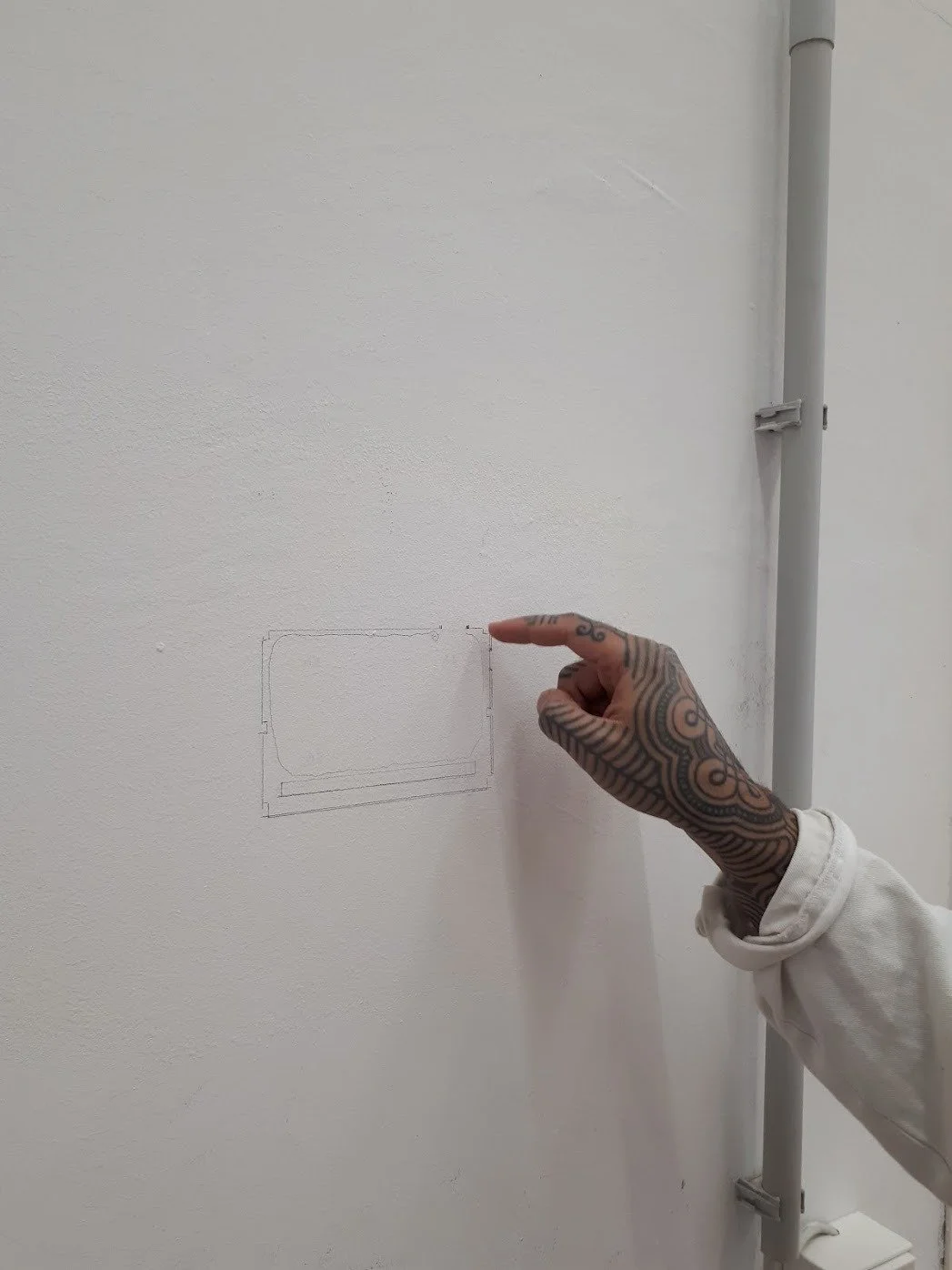
untitled (drawing of a space), 2021, Photo: Monika Georgieva
.
.
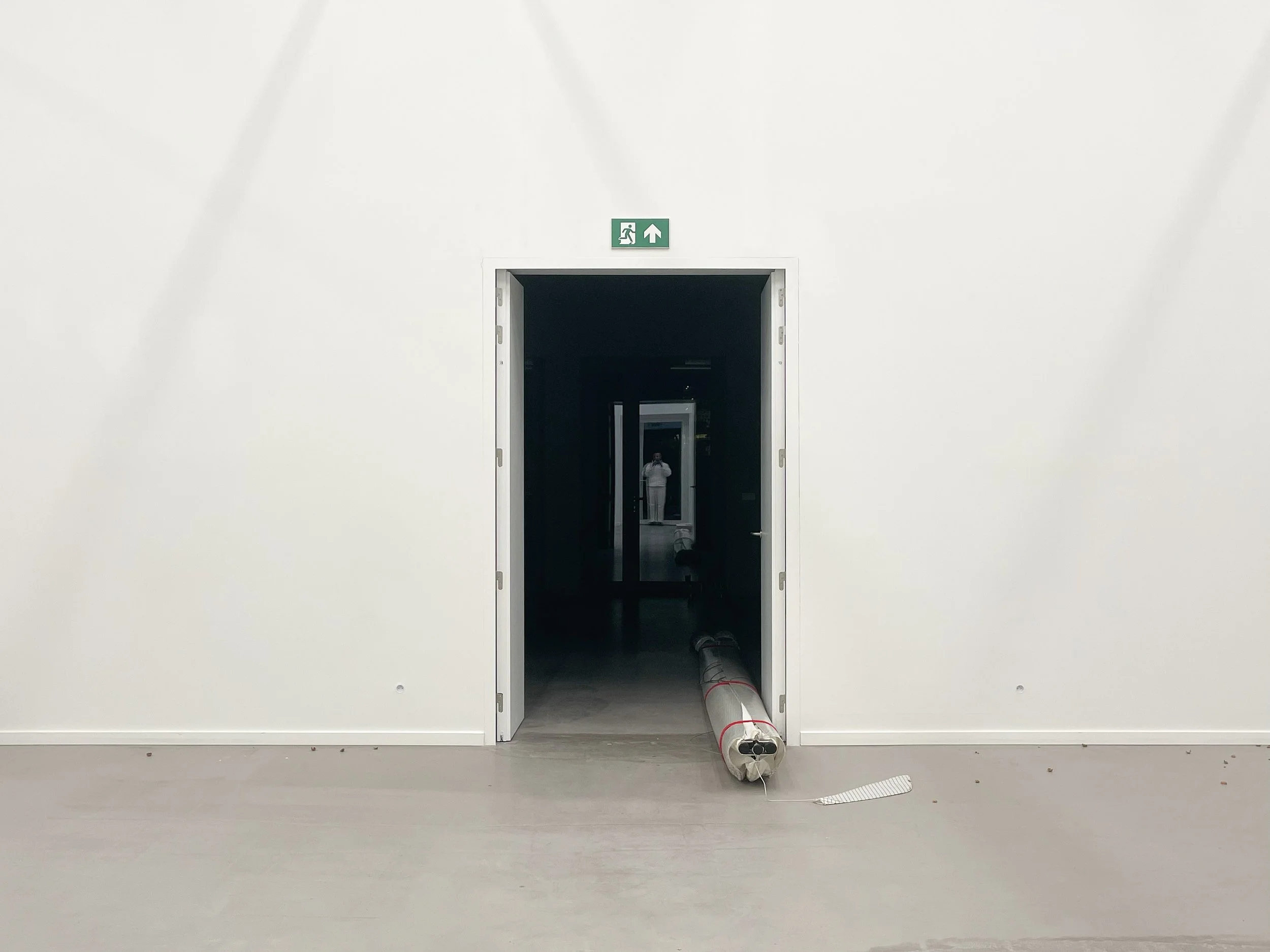
Kite (sleep-like), 2025, Jester, Genk